The Bristol Skipchen – Cooking Against the Tide

In a world ruled by money it makes perfect sense for six million tonnes of extremely high quality food to be discarded every year in the UK alone before it reaches the shops, and for those shops to chuck out another six million tonnes. That’s about half a kilo per person per day. The numbers stack up, and so does the waste. If it doesn’t feed people, so what? It may well feed ‘growth’ and ‘prosperity.’

It would all be fine, if it wasn’t so patently, obviously insane. And deeply immoral. I won’t waste words saying why. If you can’t see that, go back to watching the football. Aren’t Man U looking good! So most days I wander down the road to the Bristol Skipchen, in the Crofters’ Rights in Stokes Croft, and help serve up about a hundred delicious, nutritious meals made entirely – entirely – of food that was headed for the bin. Today we had chicken and chips with broccoli and salad, and all-day breakfasts of baked beans on toast with egg and chips. And some yummy desserts, with lashings of cream. And tea and coffee. The supply is limitless. Every suburb in Bristol could have one and there would still be no problem producing the meals, because happily there is also an abundant supply of people who are so disgusted with this waste they’re happy to help. Let me honour all those folks on farms, in restaurants, markets and other outlets who hate throwing out good food but that’s the way it works so they have to. Many go out of their way to make sure the Skipchen gets it instead. People pay what they feel, what they are able, or nothing. This system reliably produces more than enough money to pay the utilities bills and the odd overhead.

Why?

Why do we do it? For many of us the simple sanity of making sure that, instead of getting thrown away, good food gets eaten by people who want or need it is more than enough. I don’t presume to speak for my mates but there is also a general despair that ‘the system’ can be that broken while our power structures go on thinking it just needs ‘better management.’ Whatever that is. What worries me, though, is that there is in fact very little bad management involved. Quite the contrary. Don’t be fooled. All appearances notwithstanding, the people of the UK and indeed of most of the world are actually living in a highly-organised, very well-designed system, one that recurs cyclically through history. From the point of view of a handful of the super-rich, things are ticking along very nicely indeed. To illustrate: since the supposed ‘Crash’ of 2008, the financial assets alone (not the net worth) of the richest 1,000 individuals in Britain have increased by an amount greater than the national debt of £119bn. Tax that and we literally wouldn’t have the debt. Let’s have a brief language lesson. The language is Latin, the official language of the Roman Empire (although most of its educated inhabitants actually spoke Greek.) Divide et impera. Divide and rule. Panem et circenses. Bread and circuses. (As in, they’ll put up with anything if you give them enough …) The swine are doing it again. The Occupy movement made popular the cry that 1% of the world’s population owned 80% of its resources. If only. With the world population around eight American billion – eight thousand million (the English billion would be eight million million but that’s history) – that would be eighty million people. In fact it is a tiny, tiny fraction of that. A 2010 US Supreme Court declared that corporations had the same rights as citizens. If we then consider the influence of these uber-citizens, economist David Rothkopf has shown that the number controlling 80% of the value of the world’s multinational corporations is 6,000. You could easily fit all the people running the entire global show, including the CEOs of those companies and the very small number of ultra-rich who own pretty much everything else into Ashton Gate stadium and still have room for all their butlers, PR flacks and personal cooks. In his stunning analysis of the global situation, The Precariat Charter, economist Guy Standing takes it all apart and shines light into every scabrous little corner of this very deliberate, organised system. If there is a core to his thesis, it is that the objective of the super-rich, the plutocrats, and their servants in the salariat, is to downgrade the rest of us from the status of free citizens in any meaningful sense of the term and turn us into ‘human capital.’ A resource that, like money, can be taken out and used in exactly the quantity and for only the time required and then put back in the box and forgotten, requiring no attention, no resources, no life. And the more there is to spare, the better. It’s no accident that there are no personnel managers any more. Now they’re ‘human resources’ people, an ugly phrase if ever there was one. He calls us a new, emerging, dangerous class called the Precariat. Those whose lives are insecure in every respect. Precarious.

Divide and Rule

Actually there are already so many of us in the precariat that if we were all aware of it, if we could all see our common fate and our common cause, the plutocracy would be having trouble sleeping at night. But they sleep just fine, because of that good old Roman ruse, divide and rule. The precarians whose parents were old-style workers, who just want a ‘proper job’ with security, decent pay and conditions but can’t get one don’t blame the plutocrats. In fact they tend to believe every word of the ugly new liberal utilitarian doctrine they preach. The problem that they see is … another branch of the precariat. The migrants. The ones who have taken ‘their’ jobs. They’re probably right, as far as they can see. If UKIP has its way and all the migrants are chucked out and the doors closed to Europe, it is just possible that many more would get a job – on the minimum wage and a zero-hours contract. No paid holidays, of course. And quite possibly a lower minimum wage than we currently ‘enjoy’ because it’s from nasty old Brussels that the only significant pressure on higher minimum standards comes. The meat in the sandwich section of the precariat consists of a rag-tag collection of your friendly neighbourhood enemies: dole bludgers, migrants, Roma, druggies, ex-cons, even those pampered, over-privileged people with disabilities – any of the classes who regularly appear as demons on the front page of the Daily Mail. Most especially migrants. Why shouldn’t we hate them? If for no other reason, such as they’re just like us, people doing what they can to survive, then, perhaps, because it’s entirely possible that we, or our children, will end up in the same boat. It’s frighteningly easy to fall into this ill-assorted class these days, with so many laws to break, so many drugs around and so many cops available to bust the users. (Cops who would be far more gainfully employed catching white-collar criminals. But we all know that. Wonder why it doesn’t happen?) Migration, too, could easily be your or your kids’ fate. Why would your kids stay here, with the grim prospects hanging over them? At least if they can get into somewhere outside the EU they wouldn’t have that huge student loan hanging over their head, destroying their hopes. The student loan that bought the crap degree that for so many has turned into a part-time job tending bar. And if we migrate, or our kids, we wouldn’t want to be treated like that. Actually there are significantly more Britons living and working abroad than there are migrants in Britain, so the risk is perfectly real.

But the two essential reasons not to wallop the victims are utterly simple. One: they’re not to blame. They may, in some part, be an obstacle, but they are not the cause. Two: They are actually acts in that great, attention-diverting circus. ‘They’, the global engineers, need us to blame our fellows. A really good reason not to.

Then there’s the third part of the precariat – the entrepreneurial young go-getters who spend their lives writing proposals, endlessly networking, up-dating their CV’s, going to job interviews, putting together schemes for some nifty new initiative. All unpaid work, which is the conspicuous characteristic of all precarian lives – endless unpaid work, often done to meet crushing deadlines. Applications close on the 31st! I’ll just have to pull an all-nighter. Unpaid work, and lots of it, is common to all members of the precariat. Forms to fill. Trick questions. Get them wrong and poof! goes your meagre benefit. Interviews for non-jobs. Ad nauseam. The third lot don’t like the migrants, either, and tend to view the resentful, under-educated offspring of the old proletariat as a hopeless, useless drain on scarce resources. People who should stop whingeing, get off their bums and make something happen, dammit. Everyone blaming every-one else. All looking the wrong way, egged on by the mass media which is owned and run by … guess who? No. Things are ticking along just hunky-dory, if your home is a boat the size of Colston Hall tooling around the Med.

Bread and Circuses

So where does that fit in? The policy of cheap food and entertainment? They haven’t bothered too much about the bread bit, because they don’t have to. The Roman circuses happened only occasionally. These days the circus never stops. Just sit on a bus and look around. Everyone’s staring at a screen, gulping down a steady stream of gaudy media and endless chatter. Full-time circuses, regularly spiced up with messages of fear – of other precarians. The Romans would be green with envy.

Wake up!

We just have to wake up. Don’t be divided. Don’t watch the circus. We can change the world in three simple steps. One: stop blaming other precarians. Every chance you get, tell them they’re your sisters and brothers and explain why. Two: Turn off the circus. It’s a phone. Use it as one. You’d be amazed at what happens when you stop distracting yourself with trivia. Three: Do something disruptive. Start another Skipchen, for instance. Because if you start thinking about, doing stuff for others, they do it for you. Then miracles start to happen.

Stokes Croft – Haight Ashbury North

For the Chris Brake Show – http://chrisbrakeshow.com/

For three unforgettable days in 1969 I found myself in San Francisco. No, I didn’t get to smoke hash and dance in the street, due to certain restraints on my fulsome embrace of the Suburb of Love. I had arrived as a stowaway on the SS Richwood, a broken-down tub that had been around the world delivering aid rice to Indonesia, where I boarded her. Because I was being deported in a couple of days I was assigned a security guard who got bored after the first day and took me around in his Mustang, complete with a radio-powered car phone. I’ll never forget crossing the Oakland Bay Bridge and seeing a dude with long black hair flying in the breeze as he zoomed by in a Cadillac convertible with the hood down. I’d never seen a guy with hair that long own anything more valuable than a guitar.
We fetched up in Haight Ashbury. Man, what a scene – street art everywhere, all kinds of marginal freaks doing their thing, exactly what I expected. More than once I sneaked a look sideways, checking for a chance to do a runner. I probably could have, but the guy was such a decent skin I couldn’t land him in it like that.

Time has passed and so has the Haight. But the spirit lives on in Stokes Croft, that most virtuously wiggy part of Bristol heaving with, well, the same really – street art everywhere, all kinds of marginal freaks doing their thing. Welcome to Haight North – north in space, north in time (if in fact time moves up and forward, which I sometimes think …nah. Too deep. Forget it.)

Come with me. I rise and am inspired from 7.30 to 12.30. Having put in my morning’s work writing, I slip down the hill to Gloucester Rd, the longest row of independent stores left standing in Europe. The Glozzer and its myriad friends has beaten off attempts by Sainsbury’s, Tesco and Waitrose (the big three supermarkets) to build a megastore and destroy the business base of all those hardware shops, fishmongers, organic food stores, pubs, greengrocers, hairdressers and off-licences (liquor stores, known as ‘offies’) and God-knows-what-else. Bring it on, ya corporate raiders. The city wouldn’t dare give you your permits. We’d burn their arses down.

I stroll towards the centre and arrive after an always entertaining walk at Stokes Croft, that crazy hotspot bordering on the immigrant areas of St Pauls and Easton. Every day – yes, every one, one of the walls will sport a new piece. Don’t ask who funds all those cans of spray paint. No idea. It just happens.

This is the land of the million-pound wall art. Literally. I’m talking about Banksy. Check the pics. He’s been around for a decade or more. He? They? No-one knows for sure because Banksy is a massive exercise in anti-celebrity. There are only two things known for sure about Banksy: he’s a Bristolian artist of huge wit and artistic talent, and anyone who can get there their mitts on one of his pieces are quids in for a cool million. Yep. Thats £££££££££, not $$$$$$$$$$.

A few months ago a cricket club whose door he had used as a canvas were going bust and decided to sell the door. Hold hard there, says the council, that’s public property. Banksy is a public asset and we’re claiming the door. Next morning there was another little Banksy on the wall stating unequivocally that the door belonged to the cricket club. Which got a whole new lease of life from  the piece.

I love this place!

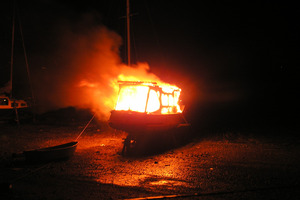
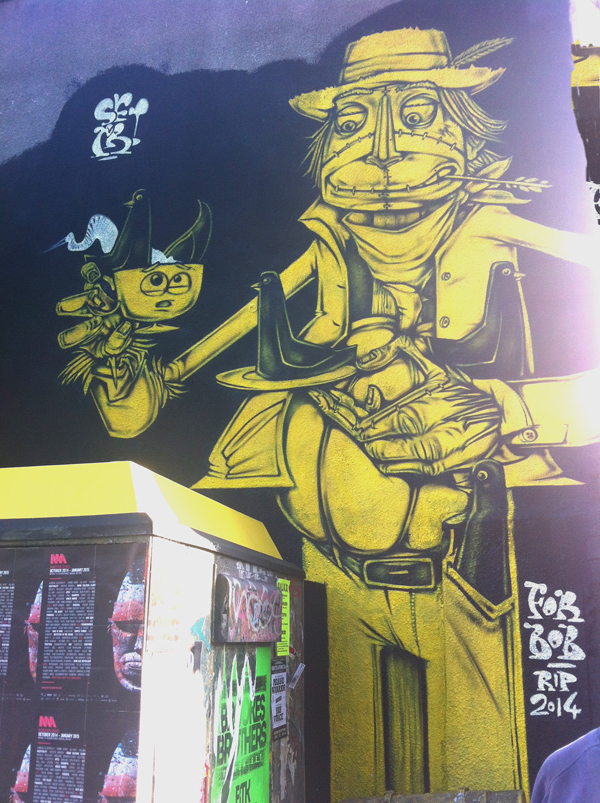
My dear, mad friend Bob Crane was cooking his breakfast on candles in his council flat (apartment) because he’d had fights with the utilities and they’d cut off his power and gas. He died in the resulting fire. A crime for which the bastards will never be called to book. One of the funniest people I’ve ever known, even though he was mad as a meat-axe. And the most generous. Within days the tributes were appearing all over the walls. The picture of Bob depicted as a scarecrow with birds in his pockets, his tea-cup and plate is my favourite. We miss him. I was distraught but those pieces helped.

RIP Bob Crane
RIP Bob Crane

Then the Skipchen opened. Food wastage in the West is beyond obscene. At the Skipchen we take a little chip out of that. (Skip=dumpster.)  The numbers: 12 million tonnes a year wasted in production and retail in the UK alone. That’s 540 grams per person per head per day – enough to actually feed everyone. We could feed everyone on the food we throw away and send everything we actually buy to people who need it, and they are legion.

So at the Bristol Skipchen (https://www.facebook.com/bristolskipchen?fref=ts) we rescue food and serve it up. Up to a hundred meals a day. If we’d been going when Bob needed to cook on candles I’d still be pissing myself laughing at his gags.

The wonderful, or terrible, thing is that we don’t even need to dumpster-dive any more. Restaurants and shops call us up and ask us to take their surplus away to feed people. Most of them hate throwing good food out – sane people who know how utterly bent out of shape that is. But the money system, competition, blah blah blah makes it necessary.

Something has to change. This thing is broken. As Mao said, a small spark can start a prairie fire. Open one near you. You’ll never do anything more rewarding.

Over and out Indianapolis, and anyone else reading.

The Rest of the Tale

As anyone who has read Orwell’s ‘Homage to Catalonia’ knows, revolutions are unstable. Because they are usually led by idealists pursuing differing objectives they can be blown apart by differing aspirations too passionately believed in. Alternately or sometimes simultaneously, the consequences of the powerless suddenly acquiring power can bring human weakness to the fore.

The Skipchen, although we religiously served only donated surplus food to the point that if no-one had donated salt we served unsalted meals, nevertheless had expenses. Petrol for the collection van. Rent, small but not free. Electricity. So I made a couple of lockable collection boxes for donations. Every night after we were closed the trio who had started the whole thing took the collection boxes out the back, unlocked and emptied them. Everyone in the box’s vicinity was well aware that donations could be generous. We weren’t talking a couple of quids’ worth of coins here, and I waited for some kind of accounting to be declared.

And I waited. We waited. Nothing. It went on so long I eventually broached the subject with Sam, who identified himself to anyone who asked as the founder, asking when we would get to see the financial picture. No, he replied, we weren’t going to bother with anything so formal.

“Hang on,” I objected. “When you’re working with volunteers, who can plainly see that there is a not insignificant amount of money coming in, they are kind of entitled to know what happens to it. I can knock up a spreadsheet if you like.”

“Maybe,” replied Sam. “I’ll talk to the others about it.”

A couple of days later the new rosters were posted. I had been doing about twenty hours a week. My name was entirely absent from any roster. I spoke to a couple of my friends among the other volunteers about it. No-one wanted to get involved, rock the boat, blah blah.

The Skipchen was a success. There were plenty of volunteers available and I realised that my ‘friends’ reaction was a fear that if they said anything they would get dropped too. Disgusted, I slung my hook and left them to it. Within a month, the Skipchen closed ‘temporarily’ for the summer. Sam and the other two had decided to tour the summer festivals ‘spreading the word.’ Yeah, right. Read: cash in on the fame to freeload on every festival going.

A couple of months later I ran into a fellow former volunteer on the street. “Was the Skipchen going to reopen?” I asked.

“No. It’s over. Haven’t you heard?”

“What?”

“Sam had to go into rehab for his coke habit.”

I guessed I had had my accounting at last.

IMG_1682
Hokusai lives on Jamaica Street wall.
IMG_1685
So does Breughel. A deft combining of Japanese print artist Hokusai’s (1760 – 1849) famous Great Wave with a detail from, I’m fairly sure, a painting by one of the Flemish Breughel family (late mediaeval – early Renaissance.)
Sniper & Son – Banksy
Banksy: Sniper & Boy with inflated paper bag. Listen for it …
Graffiti monster
Graffito – The Demon Drink – on the wall of the Bristol Bike Project, a cool Stokes Croft co-op which refurbs bikes and sells them cheaply to the needy, and lets people use their full bike workshop for £5 a session.
Graffitto
Incomprehensible (to me) graffito on the wall of the People’s Republic of Stokes Croft gallery.
Palmer Ray Solicitor's graffiti frontage.
In Stokes Croft, even the lawyers are cool. Offices of Palmer Ray, solicitors.
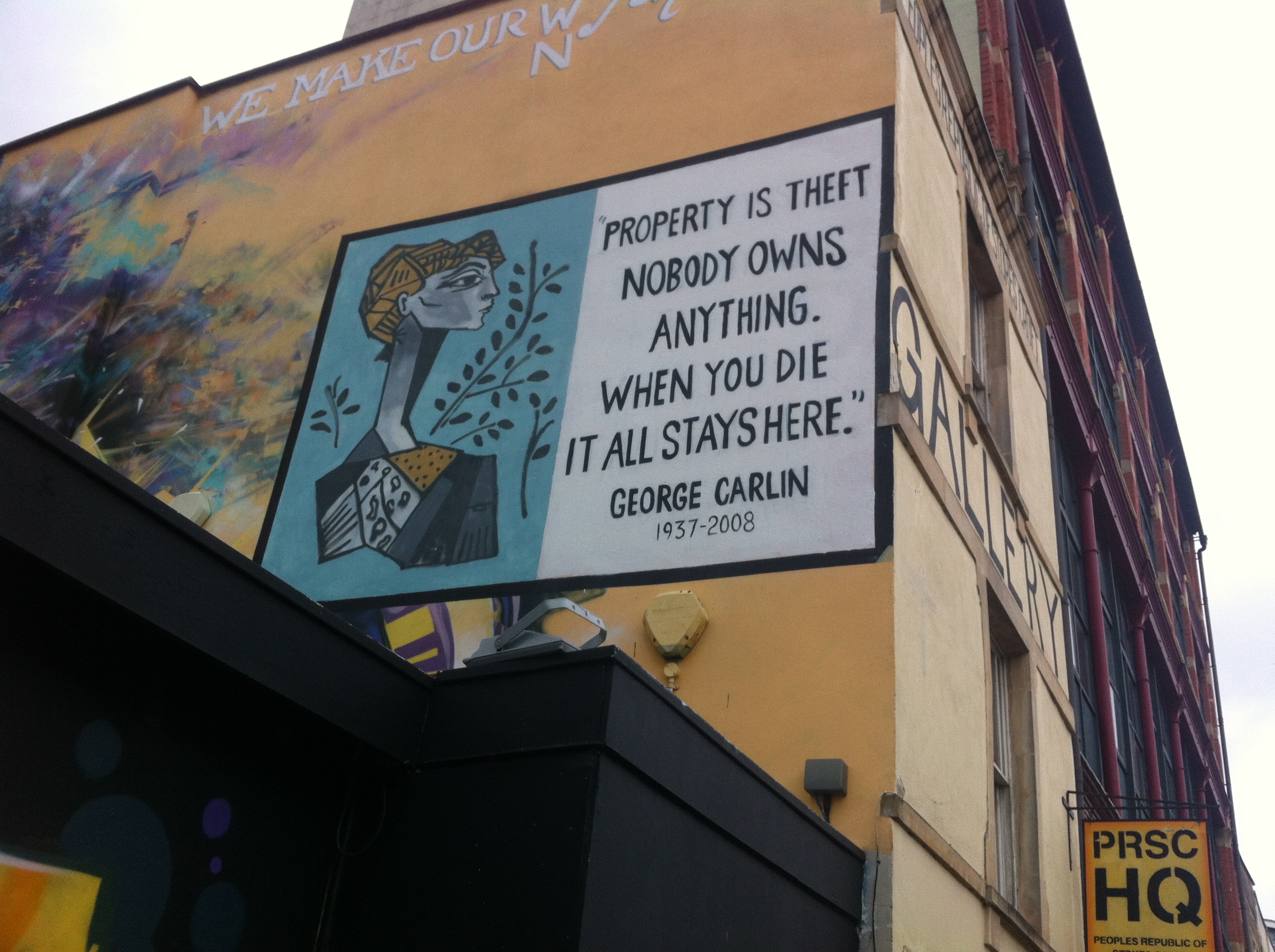
George Carlin graffiti
Headquarters of the Peoples Republic of Stokes Croft, an art and lots of other things co-op.

View From the Bridge

CliftonBridge1

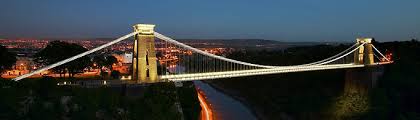
This is Clifton Bridge, probably the most photographed object in Avon county. Designed by the colourful Isambard Kingdom Brunel, completed in 1864, four years after his death. At least he knew it was being built. It is an extraordinarily lovely thing. Little-known fact: it is also an optical illusion – to offset the optical effect of the different heights of the cliffs on either side it slopes 3 feet upwards left to right in the picture, creating the illusion of being perfectly level.

It is, inevitably, the best-known suicide spot in Bristol, although fewer than 10% of the city’s suicides actually take place there, almost all male. I’ll tell you why.

Leaning over the edge you look straight down 246 feet – 75 metres. It makes your feet feel funny, which I posit is caused by your body making sure it is standing on solid ground, or perhaps blood rushes to your feet to lower your centre of gravity, thus making you feel light-headed, literally. Scary, anyway. There are much less challenging ways to top oneself. That’s why. (And they call it the coward’s way out. Hah!) But it does have the attraction, under certain circumstances, of certainty. 95% of the four who jump every year die, a far higher success rate than most alternatives. Jumping from the Clifton Bridge isn’t a cry for help. Presumably the occasional survivor hits the water at high tide. That would mean life in a wheelchair, for sure; your spine would fly to bits as your body flattened out at whatever angle you hit, meeting the water at about 120 miles an hour. (In 1885 a woman survived because of the ballooning of her skirts. She lived a healthy life into her 80s.)

I’ve had a few very difficult years. At times it has just seemed like all too much. How much more can I take, or more to the point, do I want to take? The end result is the same. After a particularly upsetting day a few weeks ago I set off on a walk and, without really planning to, ended up at the bridge. Was I being told something? Was my instinct giving me a hint? Standing on terra firma at that moment a quick end seemed frighteningly attractive. Yes. Maybe this is the moment. What a relief, if it is.

I thought by getting into position at least I would find out. Maybe, looking down at the rocks, I would simply know that it was OK.

They have halved the annual rate of jumping by putting wire barriers above the footpath, but at the Leigh Woods end there are viewing platforms with chest-high stone walls deemed too beautiful to disfigure with barriers; it would also spoil the spectacular view. I love that about Europe – in New Zealand the all-powerful health and safety Nazis who have virtually destroyed Guy Fawkes night wouldn’t hesitate.

So there I was, sitting on the parapet with my legs dangling over 200-odd feet of space, rocking gently back and forth, knowing that if I rocked just a little further I would have slightly less than four seconds to think whatever I might think in those four seconds. That, in those circumstances, is quite a long time. A once-in-a-lifetime opportunity. I sat there for a quite a lot longer than that.

I discovered several things. First, that I had finally succeeded in ditching my childhood fear conditioning about suicide sending me to hell. I felt quite sure that wouldn’t happen because the most powerful force in the universe is benevolence. Destiny is on the side of the good guys. The Hitlers always lose. Whatever my uncertainties about deity I felt sure that the universe isn’t run by by a cruel force which punishes those who can’t take it any more.

Secondly, I felt a powerful sense that this just wasn’t my destiny. I felt as if the story of my life, though still unknown to me, had already been written and this wasn’t how it ends.

I was reminded too, of something I have known since I was young. Although a hell of a risk-taker – my mother told me later in life that from my earliest years my lack of common-sense fear was her constant nightmare – I seem to have a powerful drive to keep breathing. At times it has produced behaviour I didn’t understand at the time and only later realised were about self-protection. This isn’t fear. I wasn’t afraid to jump. It seemed a pretty attractive option, even gazing down at the distant rocks. But there was something strong that I would have had to tear myself free of. I couldn’t have just slipped off. I would have had to hurl my self off. I’m not sure I could have done it. It’s a strong force, like electromagnetism, and as we know, that’s more powerful than gravity. I suppose everyone has that to some degree, although we do read of people calmly stepping off cliffs or shooting themselves. Not me.

Although I’m listing these things in sequence, they weren’t a sequence. All sorts of things were going on simultaneously. The whole time I sat and rocked I was in connection with the suffering my suicide would cause, and painfully aware that it wasn’t enough. Numerically, I mean. It would savagely hurt a very, very few people. Too few. This was not a good feeling or a good thing to reflect upon even now. On the other hand, there was no-one it would please, which should have offset its inverse corollary but didn’t.

I had made the discoveries I needed to make: this wasn’t my destiny, and the suffering I feel intermittently is too far short of the hurt my suicide would cause, so the whole thing was a no-go.

I wasn’t quite ready to get down. It was a special place, a moment in time. Unfortunately none of my discoveries had cheered me up even slightly. The opposite, if anything. But it felt nice, sitting there, rocking, looking down at my unattainable quietus.

Then an arm locked around my neck, I was dragged rapidly backwards and two guys were sitting on me.

CCTV. I could have guessed, but I just wasn’t thinking about it at the time.

So that was that.

Be Grateful for Small Wars

“The parishes of Fermanagh and Tyrone faded back into the mists and squalls of Ireland, and a strange light, by a series of perceptible gradations, began to fall upon the map of Europe.”

Such a beautiful sentence, written by Winston Churchill describing how, in July 1914, the attention of Britain turned from the crisis in Ireland to the looming war on the continent.

BBC 4 has just completed a chilling series – five 15-minute programmes entitled “The Month of Madness”, historian Christopher Clarke’s pellucid exposition of the appalling sequence of events which burst like a cataract of blood from the barrel of Gavrilo Princip’s pistol when he assassinated Archduke Ferdinand of Austro-Hungary.

All Princip wanted was a united Serbia. Bosnia, an outpost of the Austro-Hungarian empire, was in fact only 43% Serbian by ethnicity, but Serbian nationalists believed passionately that it belonged in the Kingdom of Serbia. The Black Hand, Princip’s armourers,  thought the assassination would cause a backlash from Vienna which would cause Serbs to rise and throw off the imperial yoke.

What happened instead was a war involving 65 million combatants, caused 20 million deaths and an uncounted number of broken lives, ruined four empires and triggered the Bolshevik revolution.

Objectively, the cause of the war was a chain reaction sucking one alliance in after the other. The Austrians were outraged at the murder of the moderate son and heir apparent to the 84-year-old emperor Franz-Josef. In their eyes Belgrade had done nothing to prevent the machinations of the powerful secretive organisation known as the Black Hand and must be punished.

They asked Germany for support and were immediately given a blank cheque: do what you like, we’re with you all the way. Austro-Hungary declared war on Serbia, with no stated objectives and no exit plan.

The Russians had always seen themselves as part of a greater Slavic, Orthodox realm. It was inevitable and obvious they would come to Serbia’s aid. The Austro-Hungarians, records show, scarcely considered the issue. The Germans were more strategic – Russia was in a process of extensive military development and the Germans calculated that war with them, being inevitable, was better fought sooner than later.

France was a close ally of Russia. In an unfortunate accident of history a scheduled Franco-Russian summit took place in St Petersburg early in the crisis. The hawkish French president Raymond Poincaré urged the Russians to ‘be firm’ and, astonishingly, at the formal banquet he raised his glass to toast “the next war.”

Within days, the Russians were mobilising. France followed suit.

The British initially wanted no part of it. But when the Belgians refused passage to the German army to attack France the Germans charged in, something the British could not tolerate; they too, on the 4th of August, declared war.

From complete and unthreatened peace on June the 28th, it took only 38 days for the situation to spiral out of control and cause the Great War.

Why, really? I wrote about the ‘objective’ causes of the war, but they were in fact largely subjective. The real cause of the war, in my opinion, was the thirty years of peace which preceded it. Britain, with  the Boer war recent in its memory, was the lone reluctant party. Military hawks, with powerful armies, will not sit in their barracks forever. To them, a military career that never sees them fire a shot in anger is a disaster, a pointless life. Likewise their political masters, the war ministers (“Defence Ministers”) who deploy them, the cushioned politicians who spend their days with the generals endlessly discussing weaponry and its destructive capabilities and being whizzed around in helicopters, cruisers and jets, ogling the sexy paraphernalia of warfare and making patriotic speeches.

Even I am not immune to the effect of a gun in the hand. Many years ago I was one of a four-man crew conducting a geological survey of the Gibson Desert in Western Australia. I was the cook and logistics person and was often left alone for days while the geologist, his assistant and the mechanic made forays around the area. There was a shotgun. I had never used a firearm. Sometimes, in boredom, I would take it out. Break it open, look down the barrels, fit a cartridge, lock and cock it.One day I was doing this when a crow walked into the clearing in front of the camp.

The crow strutted around in that amiable, cocky manner common to crows. I took aim. And then I pulled the trigger. I was horrified. I like crows. But I had just killed one. Why? Because the gun was such an interesting thing. For its mechanics, its aesthetics, its precision and power. I wanted to use it for what it was designed for.

I feel the guilt of that crow’s death even to today. And if I was susceptible to such a trivial influence as the attraction of a mere shotgun, how much more the hawkish by nature?

So, let us be regretfully thankful, if such a thing is possible, for the Korean and Vietnam wars. They probably saved the planet from nuclear destruction; the generals had drunk their fill of murder and destruction, the populace had witnessed it in horror, and no-one pressed that button.

My thesis: hideous they may be, but small wars kill the appetite for great ones.


Tale of a Shirt

Image

Sometimes an object becomes so special that it just deserves its own special tribute. This is actually three objects, all of the same design. In 1992 Linda and I went to the Melbourne Cup, Australia’s equivalent of Ascot. While there I bought two identical, expensive white shirts made of Indian khadi (handspun, handwoven fabric, lionised by Gandhi as the quintessential, noble item of Indian cottage industry.) What brilliant shirts! Loosely woven, cool in the hottest weather. I loved them.

Fast forward 22 years. One has vanished, the other is looking decidedly frail. We are off to India when, almost at the last minute, I realise this is my chance to have them copied. Woohoo! Into the suitcase it goes.

Darjeeling, March. Opposite my hotel is a little tailors’ shop – two men wielding ancient machines, with a third, foot-cranked one to cover for the frequent power outages. Tailoring in India is often a Muslim occupation, and I spot a calendar with Arabic writing on the wall. Putting my best foot forward, I greet them with ‘Salaam eleikum.’ Back comes ‘Eleikum salaam.’ A good start.

They inspect the shirt. Yes, no problem. This is good news – the neck and yoke are, despite their apparent simplicity, clever and complex, the reason they sit so well. I want three. Yes, no problem. How much? 350 rupees – £3.50. I’m hardly likely to quibble. How much fabric? They measure, look at me, suggest they might be improved with a little more length, give me a number.

Off I toddle to the Government of West Bengal khadi shop. Bizarre. In spite of Gandhiji’s emblematic khadi being, like mine, loosely woven and white, there isn’t a single length of white fabric in the shop.

Down to the bazaar. Nope. Nobody sells white khadi, or anything that looks like it. One particularly friendly trader suggests that ‘Sa’ib might find this an acceptable choice’ and shows me incredibly fine, soft, white, almost transparent pure cotton fabric, doubled over on the roll, i.e. very wide.

“Hmmm. Perhaps. What is it?”

“Bed sheeting, Sa’ib.” It’s perfect.

Because of the double width, he recalculates the amount needed. I huff and puff my way back up the mountain, gasping in the thin air, to the tailors.

“Atcha. Good. But not enough for three.”

I’m not up for another climb. Living here in my 20s, even as a weed of a junkie just released from three months lying around on starvation rations in a Thai prison I never suffered from the altitude. Now, 65 years old and fit, it’s exhausting.

“Is there enough for two shirts, one with a double layer?”

He brightens; clearly thinks this a good idea.

“Yes, Sa’ib.”

Two days later I pick up three shirts of the same design – one single weight, one double weight, and the skilfully repaired original, thrown in gratis.

An entirely lovely transaction.

Three weeks later I am in Spain, walking the Camino de Santiago. What am I wearing? The double-weight shirt. It’s superb – soft but strong, warm in the sometimes chilly early spring, breathes better than any synthetic, dries quickly. But comes back with a blue stain across the back from my back-pack. I treat it with a product for whitening ladies’ underwear, which replaces the blue with a yellowish stain, which I treat with a good soak in bleach and voila! – a spotless white shirt again.

This is not the shirt in the picture. That is the single-weight version. Back in England, in a heatwave, I walk in it, charging up hill and down dale at 7 km/hr, my daily regime since the Camino and the reason I have gone from a 38″ to a 34″ trouser size and from intermittent depression to persistent cheerfulness. It is once again a brilliant garment. I can wash it, hand-wring it, hang it on the line for ten minutes and chuck it on again, its residual dampness dispelled by my body heat in minutes.

What a complete, simple pleasure it is to have these shirts. No-one would look at them twice, but they are gorgeous, swimming with history, precious beyond rubies.

I love them.